You spent three evenings on that proposal. The call went well, the client said "send it over," and then nothing. No rejection, no counter, just silence. Here is the uncomfortable truth: in most cases the client never reached your price. They stopped reading somewhere around page two. If you send proposals as heavy attachments, a tool like Flipbooks AI can turn them into something people actually open, but the fixes start with the writing itself.
This article walks through seven proposal mistakes that lose clients before the price page, why each one hurts, and what to do instead. Along the way you will find comparison tables, a quick audit checklist and a short tutorial for packaging the final result.
Why Proposals Fail Early
A client opening your proposal is not reading it the way you wrote it. They are scanning. They want to know three things within about thirty seconds: do you understand my problem, what will I get, and is this person credible? If the first screen does not answer at least one, attention drops fast.
Think about the context too. Your proposal is rarely the only one on the table. It sits next to two or three competitors, a full inbox and a calendar of meetings. Decision makers also forward proposals to colleagues, who read them on phones between tasks and never saw your sales call.
The Silent Rejection Problem
Clients rarely tell you why they passed. A price objection is easy to say out loud. "Your proposal was exhausting to read" is not. So the feedback you get is usually "we went another direction," which hides the real cause.
What Clients Actually Skim
Eye tracking habits on documents are consistent: headings, bold phrases, tables, images and the first sentence of each paragraph. Everything else is a gamble. Design your proposal for that behavior rather than fighting it.
💡 Pro tip: Open your last proposal and read only the headings and bold text. If the story does not make sense, a skimming client will not get it either.
Mistake 1: Opening With Yourself
The most common opening is a company history. Founded in 2014, our team of passionate professionals, our mission and values. The client did not ask for that. They asked for a solution.
The Fix: Lead With Their Problem
Start with one short paragraph that restates the client's situation in their own words. Use phrases from the discovery call. When a client reads their own language back, trust rises immediately.
| Weak Opening | Strong Opening |
|---|
| "We are a full service agency with 10 years of experience." | "You told us leads dropped 30% after the site redesign and the team cannot tell why." |
| "Our mission is to deliver excellence." | "Here is how we will find the cause in two weeks and fix it in six." |
| "About us" as page one | "The problem, the plan, the outcome" as page one |
Your credentials still matter. Move them to the second half, where they back up a plan the client already likes.
Mistake 2: Burying the Plan Under Jargon
Proposals written for approval by other consultants tend to sound like this: "leveraging synergistic omnichannel touchpoints to optimize conversion funnels." The buyer nods, understands nothing and quietly moves on.

Write for the Least Technical Reader
The person who signs the contract is not always the person who joined the call. Write so that a finance director who skipped every meeting can still follow the plan.
- Replace abstract nouns with actions: "we will rewrite five product pages" beats "content optimization."
- Define any necessary term once, in plain language, the first time it appears.
- Keep sentences under twenty words in the core sections.
- Use numbers: "three workshops, one report, two revision rounds."
⚠️ Warning: Jargon feels like expertise to you and like risk to the buyer. Unclear scope is the number one reason deals stall.
Mistake 3: A Wall of Text
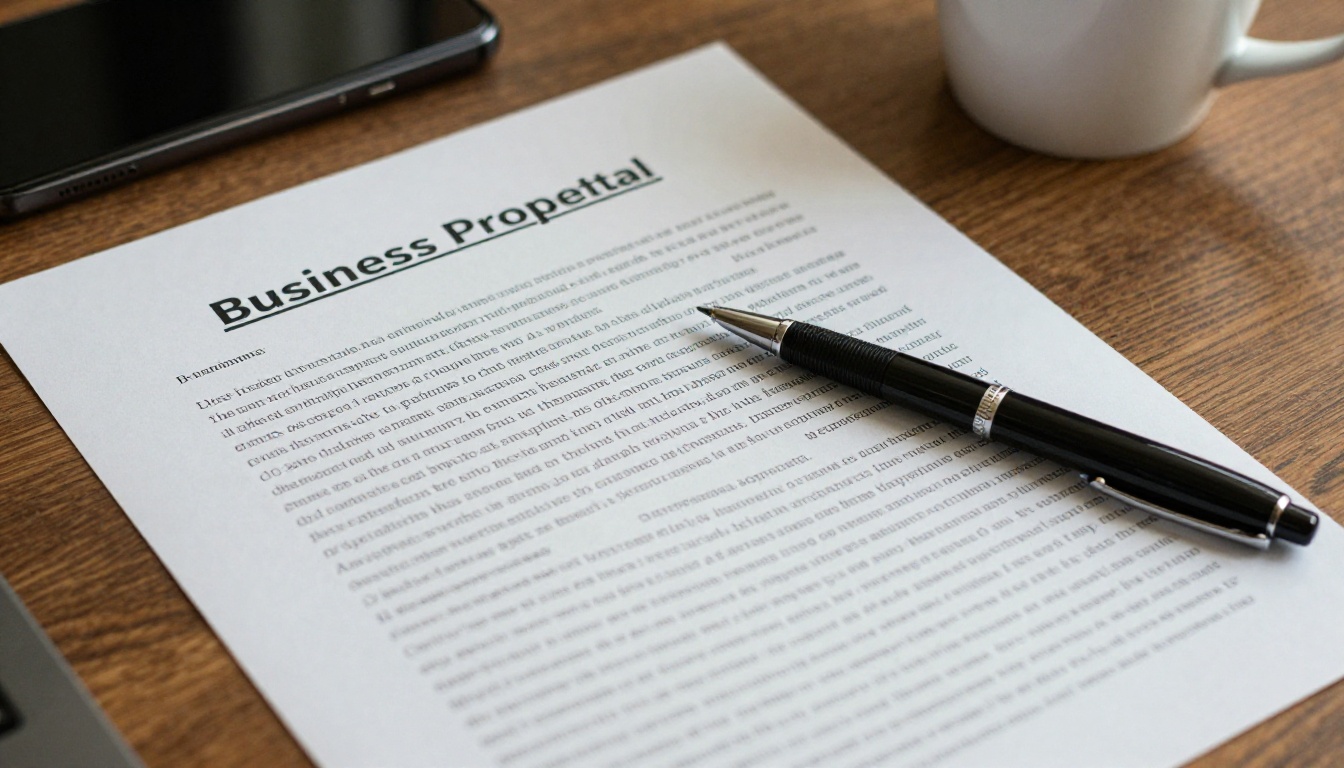
Look at the image above this section. Dense paragraphs of small type are the visual equivalent of a closed door. Many proposals run fifteen to thirty pages of unbroken prose, and clients treat them like terms and conditions.
The Fix: Make It Scannable
Break the document into sections that each answer one question. Use short paragraphs, descriptive headings, callouts and tables. Place one idea per screen.
Ideal Section Lengths
| Section | Target Length | Purpose |
|---|
| The problem | 1 short paragraph | Show you listened |
| The approach | 3 to 5 bullets or a timeline | Show the plan |
| Deliverables | 1 table | Remove ambiguity |
| Proof | 1 case study or 2 quotes | Reduce risk |
| Investment | 1 table | Make the decision easy |
| Next steps | 3 numbered items | Make acting simple |
Most strong proposals land between eight and twelve pages. If yours is longer, ask which pages exist for the client and which exist for your own comfort.
Mistake 4: Vague Scope and Deliverables
"Ongoing support and strategic guidance" means something different to every reader. Vague scope creates two fears: that you will under-deliver, and that the bill will grow later. Either fear is enough to pick a competitor with a clearer page.

Spell Out What Is In and Out
Add a short "not included" list. It feels risky, but clients read it as honesty. It also protects you from scope creep later.
Example for a website project:
- Included: six page designs, mobile layouts, two revision rounds, launch support for 14 days.
- Included: basic on-page search setup for each page.
- Not included: copywriting, photography, ongoing maintenance.
- Optional: monthly maintenance, priced separately.
Notice how much confidence the client gains from a list that small.
✅ Best practice: Every deliverable should have a noun, a quantity and a date. "Brand guidelines document, 20 pages, delivered by May 12."
Mistake 5: Sending a Heavy, Awkward PDF
Format is part of the message. A 40 MB attachment that bounces off an inbox limit, loads slowly on a phone or forces pinch-and-zoom on every page tells the client something about how you work, before they read a word.

Common Delivery Problems
- Attachments blocked or sent to spam.
- Fixed layouts that do not fit a phone screen.
- No way to know whether the client opened it.
- Old versions floating around after you send a revision.
- No way to restrict who forwards it.
Comparing Delivery Formats
| Format | Mobile Friendly | Tracking | Version Control | Feels Professional |
|---|
| Large PDF attachment | Poor | None | Weak | Average |
| Slide deck file | Mixed | None | Weak | Average |
| Shared document link | Good | Limited | Good | Average |
| Interactive flipbook link | Excellent | Strong (Professional plan) | Strong | High |
A flipbook is a page-turning, browser-based version of your PDF. It opens from a link, works on every screen and keeps one live version. The PDF to Flipbook Converter handles the conversion in minutes, and the Sales Presentation tool is built for exactly this scenario.
Mistake 6: No Proof Before the Ask
Telling a client you are great is cheap. Showing it is rarely done well. Many proposals include a logo wall and a generic testimonial, then jump to the price. That is a weak bridge.

Use Proof That Matches Their Situation
One relevant case study beats five generic quotes. Choose a past client with a similar size, industry or problem, and show the before, the action and the result with real numbers.
A simple proof block:
- Situation: Online store, 4,000 monthly visitors, 0.8% conversion.
- Action: Rewrote product pages, simplified checkout.
- Result: 1.9% conversion in 90 days.
- Quote: One sentence from the owner, with a name and role.
Keep it to half a page. If the client wants details, offer a call with that reference. Also place an image or screenshot of the real work. Visual evidence is faster to absorb than a paragraph.
💡 Pro tip: Place proof right after the plan, before the price. By the time the client sees the number, they already believe you can deliver.
Mistake 7: Hiding the Next Step
Many proposals simply end. The last page is a thank you and a signature line. The client is left to decide how to proceed, and indecision is a form of no.

Make the Next Step Obvious
End with three numbered steps, a date and a person. For example:
- Reply "approved" or book a 15 minute review by Friday.
- We send the agreement and first invoice within one business day.
- Kickoff call takes place the following Monday.
Add a deadline for pricing or availability when it is true. Do not invent false urgency, because buyers can smell it. Honest constraints, such as "I only take two new clients per month," work well.
Seven Mistakes at a Glance
| Mistake | What the Client Feels | Quick Fix |
|---|
| Opening with yourself | "This is not about me" | Lead with their problem |
| Jargon | "I might be misled" | Plain, specific language |
| Wall of text | "This is homework" | Short sections, tables |
| Vague scope | "The bill will grow" | Included and excluded lists |
| Heavy PDF | "This is clumsy" | Light, mobile-ready link |
| No proof | "Why trust you?" | One matched case study |
| No next step | "I will decide later" | Numbered steps with dates |
A Quick Proposal Audit
Before you hit send, run this ten-point check. It takes about five minutes.
- Does page one mention the client's problem within the first two sentences?
- Could a stranger explain your plan after reading only the headings?
- Are there at least two tables or visual breaks per five pages?
- Is every deliverable specific in quantity and date?
- Is there an excluded list?
- Is there one relevant proof point before the price?
- Does the document open smoothly on a phone?
- Is the price shown as a clear table, with options if possible?
- Do the last three lines say exactly what happens next?
- Have you removed every sentence that would fit any proposal for any client?
Score yourself. Eight or higher means the proposal is ready. Below six, rewrite before sending.
Offer Options, Not a Single Number
Even before the price page, framing matters. A three-tier choice shifts the question from "should I hire them?" to "which option fits?" A small, medium and large package gives the client control.
| Package | Scope | Best For |
|---|
| Starter | Core deliverables only | Tight budgets, simple needs |
| Standard | Core plus support and revisions | Most clients |
| Premium | Everything plus priority access | Time-critical projects |
How to Package Your Proposal as a Flipbook
If your content is solid, the final step is delivery. Here is a quick way to turn a finished proposal into a clean, trackable link.

Step by Step
- Create your account. Go to Flipbooks AI and sign up.
- Upload your PDF. Export your proposal from your design or word processing tool, then upload it. Conversion takes a few moments and keeps your layout intact.
- Customize the look. Add your logo, brand colors and page-turn effect. You can embed a short video introduction or an audio note so the client hears from you directly.
- Set sharing rules. Copy a direct link, or use the embed option on a client portal page. Turn on password protection so only the intended reader opens it.
- Track what happens. With the Professional plan, analytics and lead capture show which pages were opened and for how long, so your follow-up can be specific.
- Update in place. When you revise a price or scope, replace the file. The link stays the same and the old version disappears.
No watermarks appear on any plan, which matters when the document carries your brand and your client's confidence. Standard plans and above allow unlimited flipbooks, so every client can get a dedicated link.
💡 Pro tip: Use the tracking data wisely. If a client spent most of their time on the scope page, your follow-up message should start there.
Related Tools Worth Knowing
Real Scenarios Where This Pays Off
A freelance web designer replaced a 22 page PDF with a nine page flipbook. The first page stated the client's problem, the scope table was one screen, and a password-protected link went out by email. Replies came faster because the client could read it on a phone during a commute.
A small marketing agency added one matched case study before pricing and a three-step close. Their proposal conversations moved from "we will think about it" to a scheduled kickoff, simply because the next step was written down.
A consultant selling workshops introduced a not included list. Clients stopped asking about hidden costs on the call, which shortened the sales cycle.
None of these changes involved lowering a price. They involved removing friction, which is where most proposals actually lose.
Send a Proposal Worth Finishing
Clients rarely reject your price. They reject the effort of reaching it. Lead with their problem, write plainly, keep sections short, define scope, prove you can deliver and make the next step obvious. Then deliver it in a format that opens without friction.
Ready to try it? Get started for free on Flipbooks AI, browse all flipbook tools to find your best fit, or compare pricing plans to see which one adds tracking to your next proposal.



